> ## Documentation Index
> Fetch the complete documentation index at: https://docs.figr.design/llms.txt
> Use this file to discover all available pages before exploring further.
# Direct Editing
> Inspect and edit text, colour, spacing, size, and layout directly on your design.
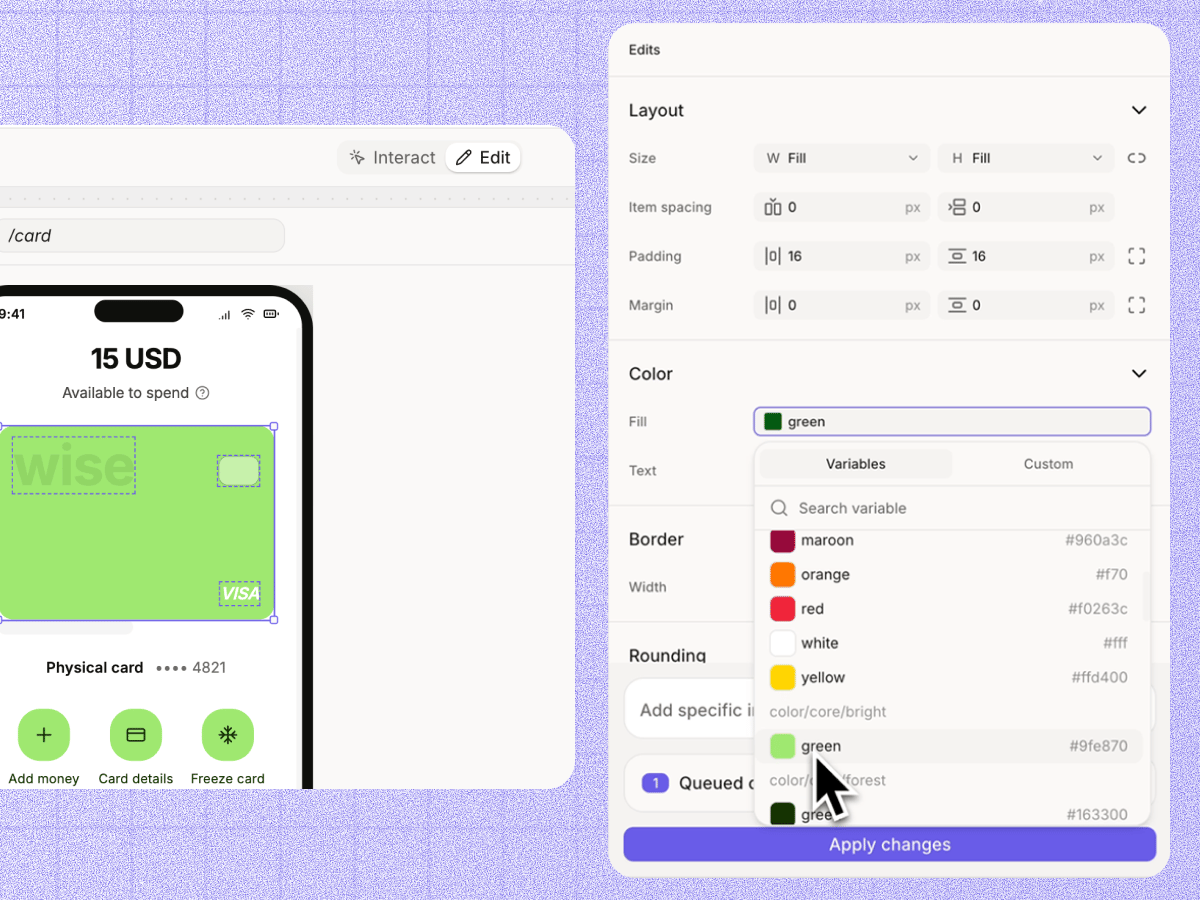 Direct Editing lets you inspect and change individual elements on the canvas without sending a new prompt for every edit.
Select an element to view its properties, edit them directly, or prompt that element when the change needs more context.
## Inspect an element
When you select an element, Figr shows the properties currently applied to it, including:
* Font
* Colour
* Size
* Line height
* Spacing
* Position and alignment
This makes it easier to check the exact values behind the design instead of relying only on how it looks on the canvas.
## Check design system usage
Direct Editing also shows how the selected element connects to your design system.
You can see whether a value comes from an attached design system variable or uses a custom value. You can also check whether an element is tied to an existing component.
If a value sits outside your design system, Figr shows a warning. You can still use the value if you want to.
## Edit properties directly
You can change the selected element without starting another prompt.
For example, you can:
* Edit text
* Change colour
* Adjust spacing
* Resize an element
* Move or align an element
* Switch to another value or variable
This works well for precise changes where you already know the value or layout you want.
## Variables and components stay connected
Direct Editing works with the design system already attached to your project.
When you edit an element, Figr applies the change back to the source with your design system and code context.
If the element already uses an attached variable or component, Figr keeps that connection unless you choose to override it.
Learn how Figr uses your components, variables, tokens, and visual rules.
Learn how screens, flows, reviews, and edits work together on the canvas.
## Use a prompt when needed
Direct Editing does not replace prompting.
Use direct editing when you know the exact change you want to make.
Use a prompt when the change needs more context, affects several elements, or requires Figr to reason through the UX.
You can prompt the selected element without leaving the editing flow.
Direct Editing lets you inspect and change individual elements on the canvas without sending a new prompt for every edit.
Select an element to view its properties, edit them directly, or prompt that element when the change needs more context.
## Inspect an element
When you select an element, Figr shows the properties currently applied to it, including:
* Font
* Colour
* Size
* Line height
* Spacing
* Position and alignment
This makes it easier to check the exact values behind the design instead of relying only on how it looks on the canvas.
## Check design system usage
Direct Editing also shows how the selected element connects to your design system.
You can see whether a value comes from an attached design system variable or uses a custom value. You can also check whether an element is tied to an existing component.
If a value sits outside your design system, Figr shows a warning. You can still use the value if you want to.
## Edit properties directly
You can change the selected element without starting another prompt.
For example, you can:
* Edit text
* Change colour
* Adjust spacing
* Resize an element
* Move or align an element
* Switch to another value or variable
This works well for precise changes where you already know the value or layout you want.
## Variables and components stay connected
Direct Editing works with the design system already attached to your project.
When you edit an element, Figr applies the change back to the source with your design system and code context.
If the element already uses an attached variable or component, Figr keeps that connection unless you choose to override it.
Learn how Figr uses your components, variables, tokens, and visual rules.
Learn how screens, flows, reviews, and edits work together on the canvas.
## Use a prompt when needed
Direct Editing does not replace prompting.
Use direct editing when you know the exact change you want to make.
Use a prompt when the change needs more context, affects several elements, or requires Figr to reason through the UX.
You can prompt the selected element without leaving the editing flow.